Our Heavenly Father's, Kingdom, the New Jerusalem!
We must start rebuilding the Kingdom here based on truth!
John 10:27 My sheep hear my voice, and I know them, and they follow me.
2 Chr 7:14 If my people, which are called by my name, shall humble themselves, and pray, and seek my face, and turn from their wicked ways; then will I hear from heaven, and will forgive their sin, and will heal their land.
Early Christians, who followed the Old Testament tradition
of celebrating Passover on the 14th of Abib, were called Quartodecimans, which
is Latin for English word ‘Fourteeners’.
In England there is another word for this that is still in use today and
it is ‘fortnight’. Therefore, Quartodecimans could also be called
‘fortnighters’. The word originates from the
Teutons of Jutland who counted nights and called a grouping of 14 nights
‘fortnight’. The Teutons were Germanic people
that originated from the tribe of Judah. In German the word for ‘fortnight’ is ‘vierzehntage’
and in Dutch it is ‘veertien
dagen’. It is quite interesting that
the word ‘fortnight’ is still in use in places where the Israelites originally migrated
to.
The Early Congregations of Jerusalem and Asia Minor were
taught directly by Jesus' Apostles to follow biblical law and celebrate
Passover on the 14th of Abib and they did not want to comply with
Rome’s law for celebrating Easter. Ever
since these early congregations, there has always been a remnant of
our Father in Heaven's followers who insist on following his biblical law for celebrating
Passover.
Quartodecimans Brief History
By 117AD, the Roman Empire was in control
of most of the white Christian populations, therefore the Romans were able mandate
their religious doctrine.
In about 155 AD , Pope Victor I became
against bishop Polycarp of Smyra for celebrating Jesus' Passover on the
fourteenth of Abib. This pope wanted Polycarp and his followers to
celebrate Easter on the Sunday following the new moon after the Spring
Equinox. This was known as the first
Quartodecimans Controversy which later started being called the Easter Controversy.
Below is a part of a letter that the
bishop of Asia wrote to Victor and
the Church of Rome:
But the bishops of Asia, led by Polycrates, decided to hold to the
old custom handed down to them.He himself, in a letter which he
addressed to Victor and the church of Rome, set forth in the following words
the tradition which had come down to him:
“We observe the exact day;
neither adding, nor taking away. For in Asia also great lights have fallen
asleep, which shall rise again on the day of the Lord’s coming, when he shall
come with glory from heaven, and shall seek out all the saints. Among these are
Philip, one of the twelve apostles, who fell asleep in Hierapolis; and his two
aged virgin daughters, and another daughter, who lived in the Holy Spirit and
now rests at Ephesus; and, moreover, John, who was both a witness and a
teacher, who reclined upon the bosom of the Lord, and, being a priest, wore the
sacerdotal plate. He fell asleep at
Ephesus.
And Polycarp in Smyrna, who was a bishop and martyr; and Thraseas, bishop
and martyr from Eumenia, who fell asleep in Smyrna.
Why need I mention the bishop and martyr Sagaris who fell asleep in
Laodicea, or the blessed Papirius, or Melito, the Eunuch who lived altogether
in the Holy Spirit, and who lies in Sardis, awaiting the episcopate from
heaven, when he shall rise from the dead?
All these observed the fourteenth
day of the passover according to the Gospel, deviating in no respect, but following the rule of faith. And I
also, Polycrates, the least of you all, do according to the tradition of my
relatives, some of whom I have closely followed. For seven of my relatives were
bishops; and I am the eighth. And my relatives always observed the day when the people put away the leaven.
I, therefore, brethren, who have lived sixty-five years in the Lord,
and have met with the brethren throughout the world, and have gone through
every Holy Scripture, am not affrighted by terrifying words. For those greater
than I have said ‘We ought to obey God
rather than man.’”
After Bishop Polycarp and the Church of Alexandria the
Fourteener biblical tradition continued.
Bishop Irenaeus (d.
202AD) of Lugdunum in Gaul (current day Lyon, France) and his followers
were Fourteeners.
The Gaelic kingdom of Dal
Riata at Iona (present day west Scotland) from 563 to about 715AD,
practiced Celtic Christianity and a Gaelic solar calendar,
were also Fourteeners. Since they were never part of Rome they were allowed to
follow the biblical date for Passover.
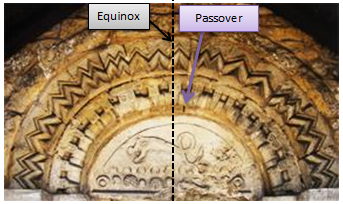
The attendees of the St.
Helena Church in Austerfield, England were also Fourteeners. The church was built in 1080AD, however, they
have a diagram above the south porch entrance that dates back to 702AD. According to Revd. Edward Dunnicliffe this
diagram relates to the time of the Synod of Austerfield and the calculation of
Easter Day. A Synod was held in
Austerfield in order to come to an agreement on when Easter was to be
celebrated. The meeting was actually
about the St. Helena church attendees and others in England who were observing
Passover on the 14th of Abib and the Church of Rome wanted them to
celebrate Easter using their calculation. This diagram was created to show their tympanum over the serpent beast
or dragon and indicated that they would still be using the solar calendar and
observing Passover on the 14th.
To understand how this diagram works, please see
this page.
Unfortunately
by about 800AD, the
Roman Catholic Church won and Easter started being celebrated on Sunday throughout
Europe, Asia Minor and Alexandria. They combined Easter with the resurrection day observance.
William
Bradford, who was a Mayflower Pilgrim, was raised at this St. Helena Church
and I’m sure he knew that this diagram reflected solar henge showing the date
Passover was to be celebrated.The Mayflower Pilgrims were
separatist, meaning they
wanted to separate themselves from the Church of England and they wanted to
follow the bible instructions on all matters of life.Plus they did not want to lose their cultural
identity; therefore, they ultimately separated themselves by relocating to
America in 1620.In America the
Mayflower Pilgrims united with the Puritan movement when they arrived and they did not
celebrate Easter.The Puritans wanted to purify the church from all Roman Catholic
practices and observe the feast days as instructed in the bible.History does prove that the Mayflower
Pilgrims celebrated
the first two feasts of the Exodus, therefore they were Fourteeners.They did consider themselves the
children of Israel. The early Puritan colonist did write a prayer
about the resurrection
of Jesus.
The bible reflects that Passover is on the 14th
day of Abib and it is to be celebrated on the selfsame day each year. Selfsame is translated from the Hebrew word 6106 ‘estem’ meaning
bone, substance or self. Meaning the date is not moveable.
Lev 23:4 "These are the appointed feasts of the Lord,
the holy convocations [assemblies], which you shall proclaim at the time appointed
for them. In the first month, on the fourteenth
day of the month at twilight, is the Lord's Passover.
Deu 16:1“Observe the month of Abib
and keep the Passover to the Lord your God, for in the month of Abib the Lord your God brought you out of Egypt by night.
And you shall offer the Passover
sacrifice to the Lord your God, from the flock or the herd, at the place that the
Lord will choose, to make his name dwell there.
Exodus 12:17And ye shall observe the feast of unleavened
bread; for in this selfsame day[H6106
etsem]have
I brought your armies out of the land of Egypt: therefore shall ye observe this
day in your generations by an ordinance for ever.
Joshua 5:10And the children of Israel encamped in
Gilgal, and kept the passover on the fourteenth
day of the month at even in the plains of Jericho. And they did eat of the
old corn of the land on the morrow after the passover, unleavened cakes, and
parched corn in the selfsame day [H6106
etsem].
Today the Quartodecimans Controversy continues since we now have
four different methods for determining when Passover
is to be observed, as described below and shown on the table below:
1.The Catholic Church Easter
celebration, in green, is celebrated
the Sunday after the first new moon that occurs after the spring equinox.
2.The Jewish Passover tradition, in blue, is celebrated on the 14th
day of Nissan according to their lunar calendar. Nissan starts on the new moon
closest to the spring equinox.
3.The Worlds
Last Chance Passover, in purple,
is celebrated the 14th day of the first month according to their
lunar calendar.These dates were based on the new moons in
Kentucky.
4.The
Christian or Biblical Quartodecimans Passover observers, in
orange, that celebrate on the 14th day of Abib according
to the solar calendar of Enoch,
Jubilees
the Dead
Sea Scrolls, the Coptic
Solar Calendar, etc .The Passover
feast is actually on the same day each year; however, using the Gregorian calendar
to reflect the date makes it look as though the date changes. This is
the only calendar that celebrates Passover on Abib 14 and on the selfsame day
each year.
Conclusion
The Roman Empire was brutal towards true Christians including
those who celebrated Passover on the 14th of Abib. There were many Christian
persecutions and executions during that time including Polycarp who was a
Fourteener. Due to this many Christians
betrayed their faith and began conforming to the Roman Catholic Church
doctrine. This Easter calculation was then
allowed to spread, throughout the white Christian nations, to the point now
when a Christian states they celebrate Passover on Abib 14 that is seen as foreign
by fellow white Christians. Let’s began
to celebrate Passover again like the original Fourteeners did in obedience to our Father in Heaven. Let’s remember what Jesus told
us:
John 15: 18 If the world hate you, ye
know that it hated me before it hated you. If ye were of the world, the
world would love his own: but because ye are not of the world, but I have
chosen you out of the world, therefore the world hateth you. Remember the word
that I said unto you, The servant is not greater than his lord. If they have persecuted me, they will also
persecute you; if they have kept my saying, they will keep yours also. But
all these things will they do unto you for my name's sake, because they know
not him that sent me.